
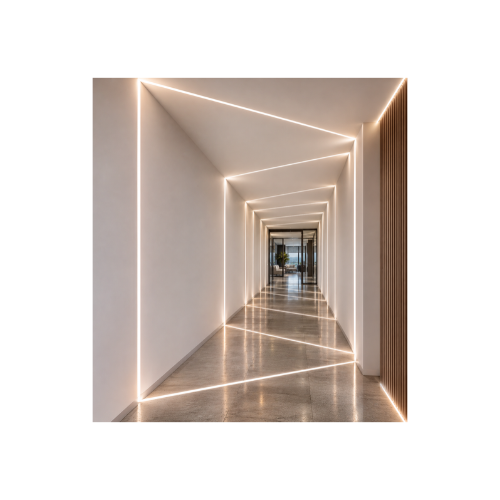
Geometric Lighting: Where Architecture Meets Creativity
One of the most compelling developments in contemporary lighting design is the use of geometric LED patterns.
As illustrated in this architectural corridor, continuous lines of light can extend across walls, ceilings, and floors, creating a sense of movement and visual continuity.
Rather than relying exclusively on traditional ceiling fixtures, designers can integrate lighting directly into architectural surfaces to establish a unique visual language.
Angled lines, repeating shapes, and carefully positioned illuminated details can transform an otherwise minimal environment into an engaging architectural feature.
This approach is particularly effective in modern commercial spaces, galleries, hospitality interiors, and contemporary buildings where visual identity plays an important role.
Linear LED Lighting for Seamless Architectural Integration
Linear LED lighting provides flexibility for creating clean, uninterrupted lines of illumination.
When combined with suitable aluminum profiles and diffusers, LED strips can be incorporated into recessed channels, wall details, ceiling features, and other architectural elements.
These installations can emphasize the geometry of a space while maintaining a minimalist appearance.
Integrated linear lighting is particularly valuable for projects that prioritize clean surfaces and concealed light sources.
By coordinating lighting placement with the architectural design, project teams can create a more cohesive and refined result.
Creating Depth, Direction, and Visual Movement
Lighting can influence how people perceive the proportions and direction of a space.
In corridors and transitional areas, linear illumination can guide the eye toward an architectural focal point or emphasize the length and perspective of the environment.
Repeating illuminated patterns can create rhythm, while changes in direction introduce visual interest.
The contrast between illuminated lines and surrounding surfaces adds depth without requiring additional decorative elements.
For architects and interior designers, this technique offers an opportunity to make lighting an integral part of the building’s character.
Modern Applications for Creative LED Lighting
Architectural LED lighting can be adapted to a wide variety of environments.
Commercial interiors: Integrated lighting can enhance reception areas, corridors, meeting spaces, and contemporary office environments.
Hospitality and entertainment: Geometric lighting designs can establish a memorable atmosphere in hotels, lounges, restaurants, and entertainment venues.
Retail environments: Linear illumination can highlight architectural features and contribute to a distinctive brand experience.
Residential architecture: Concealed LED strips can enhance hallways, staircases, ceiling details, and modern living spaces.
Galleries and exhibition spaces: Carefully designed lighting patterns can complement contemporary architectural concepts and visitor circulation.
Each application requires appropriate product selection, installation planning, and consideration of the intended lighting effect.
The Importance of Light Quality and Installation
Achieving a clean architectural lighting design requires more than selecting an LED strip.
Several factors influence the finished result, including colour consistency, diffuser selection, mounting profiles, power supply compatibility, and installation accuracy.
For continuous lines of illumination, suitable profiles and diffusers can help reduce visible LED dots and create a more uniform appearance.
Lighting designers should also consider brightness, glare, and the relationship between decorative illumination and functional lighting.
Where LED lighting is integrated into floors or other accessible surfaces, the installation must use appropriately rated products and mounting systems suitable for the intended conditions and loads.
Careful coordination between architects, electricians, and installers is essential to achieving both visual quality and reliable performance.
Energy-Efficient Technology with Creative Flexibility
LED technology has expanded the possibilities of architectural lighting.
Its compact form factor allows light sources to be integrated into details that would be difficult to achieve using many conventional lighting systems.
LED strips and linear fixtures also offer a variety of colour temperatures, output levels, and control options, depending on the selected products.
When properly designed, LED lighting can provide efficient illumination while supporting innovative architectural concepts.
This combination of performance and flexibility makes LED technology an important tool in contemporary interior design.
Explore Architectural Lighting Solutions by Maxtar Lighting
At Maxtar Lighting, our selection of LED strips, linear lighting fixtures, and architectural lighting accessories offers possibilities for creative residential and commercial projects.
Based in North Vancouver, British Columbia, we provide lighting options for architects, interior designers, builders, electricians, and contractors seeking to integrate modern LED technology into their projects.
Whether the design calls for subtle concealed illumination or a bold geometric lighting feature, thoughtful product selection can help bring an architectural vision to life.
Bring Your Architectural Vision to Light
The most memorable spaces often emerge when lighting and architecture are designed together.
Through geometric patterns, integrated linear illumination, and creative fixture placement, LED technology allows designers to redefine ordinary surfaces and create extraordinary visual experiences.
Discover modern architectural LED lighting solutions at Maxtar Lighting.
Maxtar Lighting — Where Architecture and Light Become One.